AI
Model Context Protocol: connecting AI takes an hour, governing it takes decisions
Most articles about the Model Context Protocol explain how it works. That's useful for a developer, not for leadership. Today, any team can connect an AI assistant to a CRM or a shared drive in an afternoon. The real question is no longer technical: what do we let the AI read, what do we let it do, on whose behalf, and who is accountable?

Recommendation: before connecting anything, list what each connector will expose, to whom, and at what level of action. Start read-only.
Up to date with the MCP specification of July 28, 2026.
What MCP is, on one page
The Model Context Protocol is an open standard that defines how an AI application connects to external data sources and tools. Anthropic introduced it in November 2024. A year later, in December 2025, it donated MCP to the Agentic AI Foundation, created under the Linux Foundation and co-founded with Block and OpenAI (Linux Foundation announcement). The protocol is now supported by ChatGPT, Gemini, Microsoft Copilot, Cursor and Visual Studio Code, as well as AWS, Google Cloud and Microsoft Azure (Anthropic announcement).
For leadership, three elements matter:
- The client: the AI application your teams use (an assistant, a development tool, an agent).
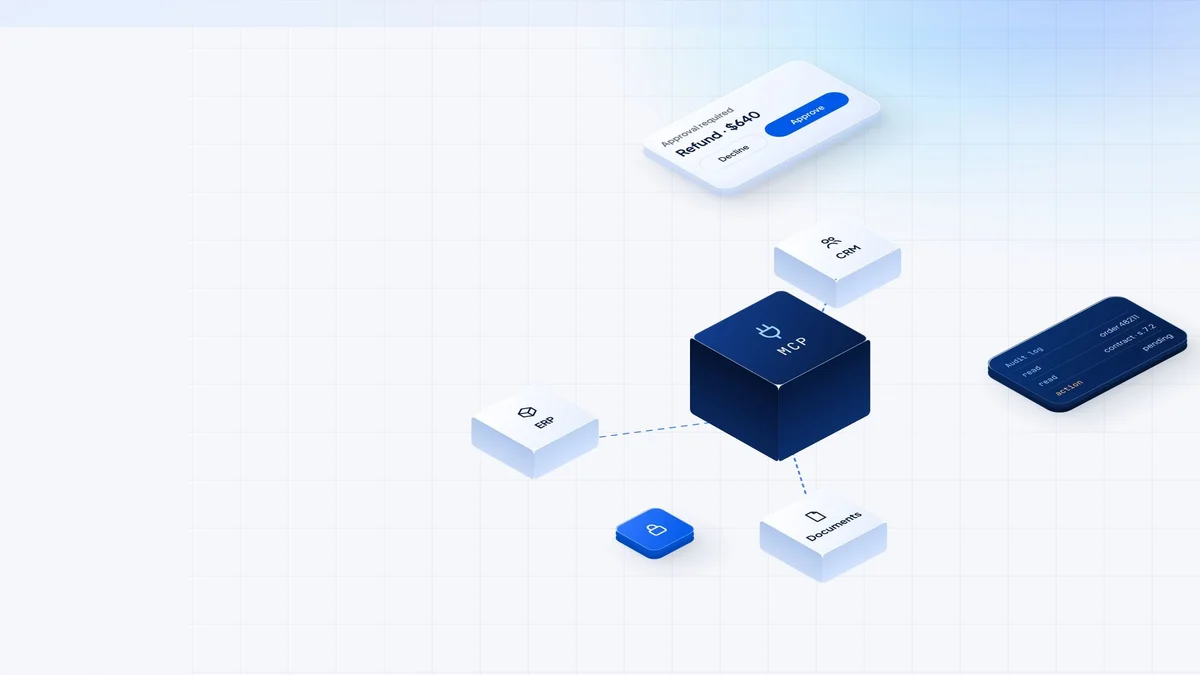
- The MCP server: the component that exposes part of your systems (ERP, CRM, document management, catalogue) in a format the AI understands.
- What gets exposed: resources the AI can read, tools it can trigger and prompt templates.
The usual image is a USB-C port for AI. It's accurate on one point: a single connector replaces dozens of custom integrations. It's misleading on another: a USB-C port doesn't decide what you're allowed to plug in.
Why articles written in 2025 are already out of date
MCP is moving fast, and several criticisms from a year ago no longer hold:
- Authentication. It was often said that MCP relied on simple API keys. Since the March 2025 revision, the specification defines an authorization framework based on OAuth 2.1. The July 2026 revision aligns it further with OAuth 2.1 and OpenID Connect, so you can rely on your existing identity provider.
- Sessions. Many guides describe a mandatory session handshake. The July 28, 2026 specification removed protocol-level sessions: a request can now be handled by any server instance behind a load balancer.
- Operations. HTTP requests now carry the method and the tool name in their headers. A gateway, web application firewall or rate limiter can filter and meter each call without reading its body.
One point still holds: authorization remains optional in the specification. An MCP server can run with no access control at all. That's exactly where the company's responsibility lies.
What MCP doesn't decide for you
MCP answers "how does the AI connect." It leaves five questions that belong to leadership.
1. On whose behalf does the AI act?
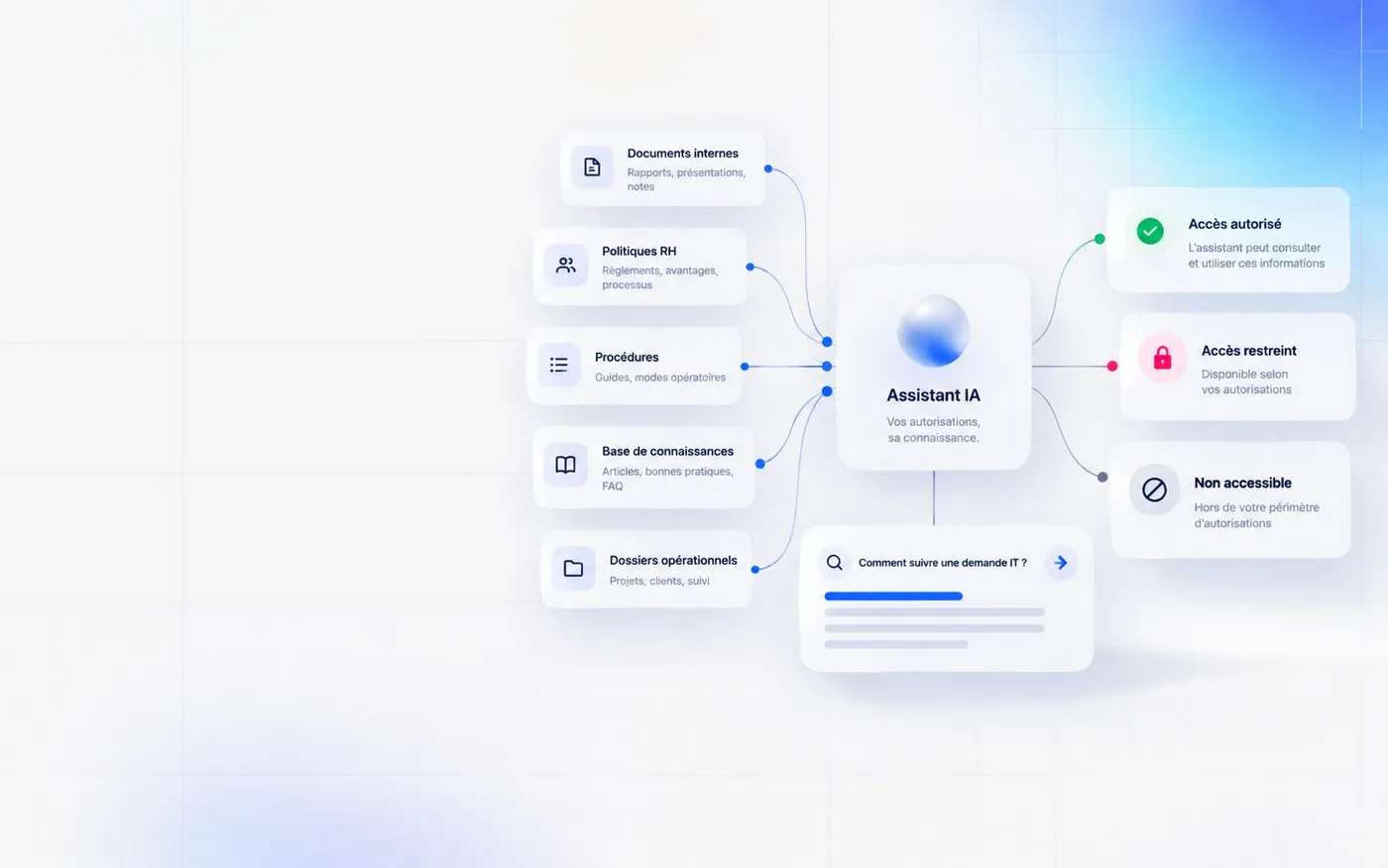
An assistant connected through a service account that sees the whole ERP gives every employee, through the AI, access they don't have in the ERP itself. The rule we apply is simple: the AI inherits the permissions of the person using it, never more. The integration must associate each call with the user and enforce their permissions in the source system; OAuth alone does not guarantee this mapping. See an internal assistant has your permissions.
2. Read or act?
Reading a customer record and issuing a refund don't carry the same risk. Classify every exposed tool into three levels:
| Level | Examples | Recommended rule |
|---|---|---|
| Read | Look up an order, a contract, stock | Allowed under the user's permissions |
| Reversible action | Prepare a draft, create a task, suggest a reply | Allowed, with logging |
| Binding action | Refund, change a price, cancel an order, send to a customer | Human approval required above a threshold |
We apply the same principle to the customer agent we're building for Shopflow: it answers, recommends and tracks orders, but it doesn't refund, grant discounts or cancel anything. Those requests go to a human.
3. Who approves, and on what basis?
Human approval only has value if the person sees what they're approving: the sources consulted, the rule applied, the amount at stake. Blind approval is a formality — see why a human in the loop isn't enough.
4. What do we keep as a record?
For every call: the user, the tool, the parameters, the response, any human decision. In Québec, Law 25 already requires informing a person when a decision about them is based exclusively on automated processing, and letting them request a review. Without a log, that obligation can't be met.
5. Which servers do we trust?
Thousands of MCP servers are published freely. A third-party server can contain tool descriptions designed to hijack the AI's instructions, or expose more than intended. Treat them like any third-party software: inventory, review, pinned versions and an allowlist of approved servers.
The real risks, without the drama
- Prompt injection. An email, document or product record can contain text that tries to make the AI act. The more action tools the AI has, the more this matters. The answer is architectural: separate reading from acting, and require approval for anything binding.
- Over-exposure. A "convenient" server that exposes an entire database instead of three specific queries. It's the most common mistake, and the easiest to avoid.
- Sprawl. Each team plugs in its own connectors, with no inventory. Six months later, nobody knows what the AI can reach.
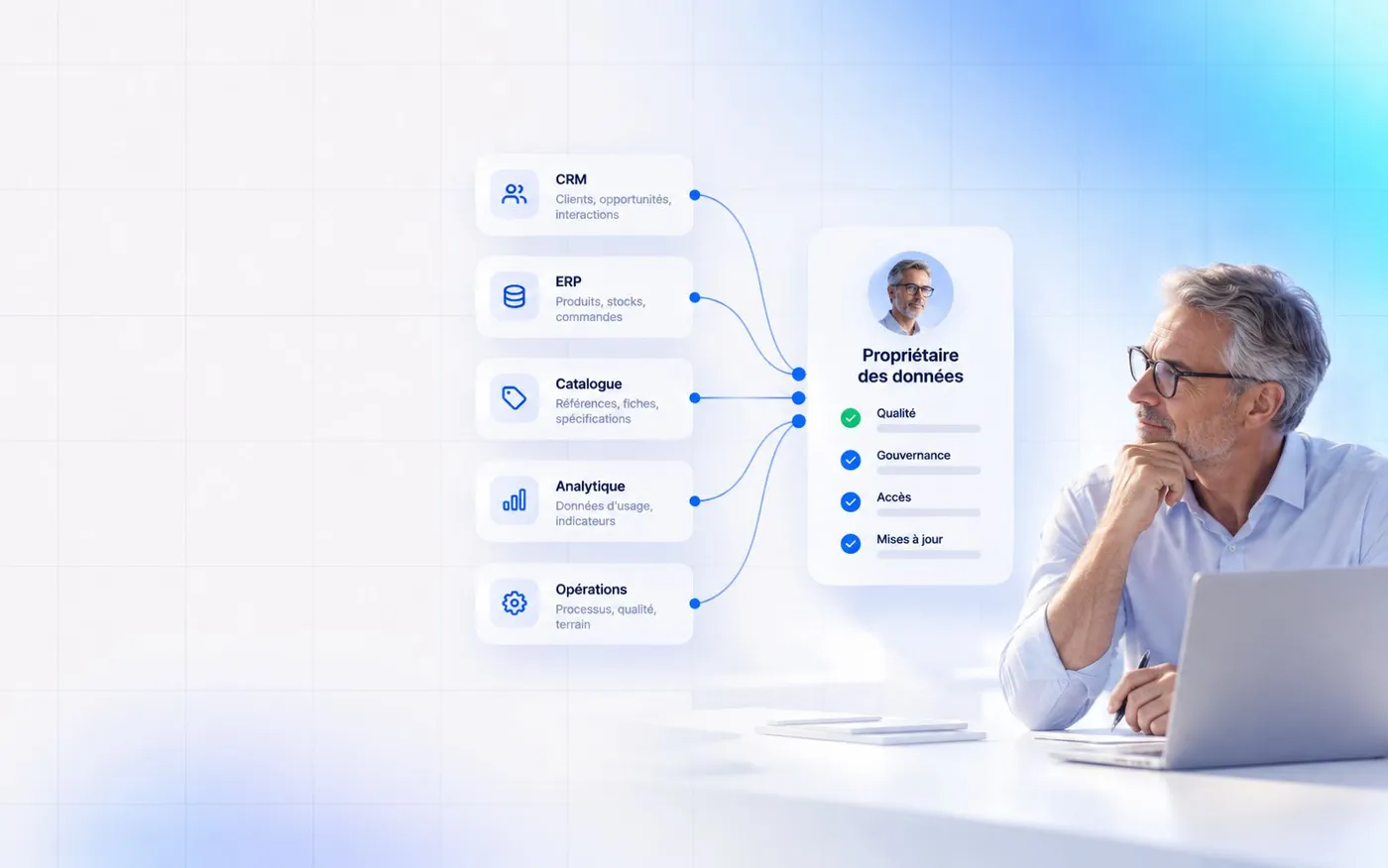
- Data quality. MCP faithfully carries wrong data. If the source data has no owner, the AI will answer confidently from outdated information — see the problem of data without an owner.
A five-step method for a company
- Pick one use case. A frequent, measurable task where errors are recoverable: finding a contract clause, an order status, a customer history.
- Inventory what will be exposed. For each tool: the data, the level (read, reversible action, binding action), the source system, its owner.
- Wire in identity. OAuth 2.1 connected to your identity provider, so the AI acts with the user's rights.
- Start read-only. Measure accuracy and real usage for a few weeks before opening any action tool.
- Open actions with thresholds and logging. Every binding action goes through an approval that shows its sources, and every call is logged.
This step is played out less in code than in integrations: an MCP server is one more integration layer that must be monitored and maintained like the others. Explore our cloud and API integrations.
FAQ
Does MCP replace our APIs?
No. An MCP server usually builds on your existing APIs. It presents them to the AI in a standard format, with a description of each tool. Your APIs remain the source.
Do we need one MCP server per system?
Not necessarily. One server can combine several sources for a use case. What matters is that every exposed tool has an owner and a defined risk level.
Is MCP secure?
The protocol provides an authorization framework based on OAuth 2.1, but makes it optional. Security therefore depends on implementation: user identity, limited scope, approval of actions and logging.
Does our data leave the company?
Data the AI reads is sent to the model in use. How it's processed depends on the provider, the contract and the hosting region. For personal information in Québec, Law 25 requires a privacy impact assessment before any transfer outside the province.
Where should we start?
With a read-only use case, on data with a clearly identified owner, and a metric measured before and after.
Conclusion
MCP solved a real problem: every connection between AI and a business system no longer has to be reinvented. It also made connecting so easy that governance becomes the real subject. The companies that get value from it won't be those that plug in the most connectors, but those that know exactly what their AI can read, what it can do, on whose behalf, and under whose control.
Nuevamed designs integrations between artificial intelligence and its clients' business systems (ERP, CRM, commerce, documents) with per-user permissions, approval thresholds and full logging. Explore our AI services.
Sources and references
Related expertise
Explore the expertiseFacing a similar challenge in your organization?
Discuss your project