Commerce
Your next storefront is an API
In B2B commerce, buyers will soon stop browsing your website. Their AI agent will query your prices, your stock and your terms. Suppliers whose data machines cannot read will drop off the shortlist without ever finding out.


A scene that is no longer futuristic
A buyer at a distributor in Montréal needs to reorder three hundred industrial supply items. She no longer visits ten websites. She asks her agent to select the three suppliers offering the best net delivered price within five days, under the terms already negotiated, and to prepare the purchase orders for approval.
The agent does not read your pages. It never sees your banner or your brand video. It queries data: a structured catalogue, a price that applies to this specific customer, availability, lead time, terms. If that information is not exposed in a format it understands, you are not beaten by a competitor. You are simply never considered.
From customer journey to protocol
For twenty years, e-commerce optimized a human journey: a search engine, a category page, a product page, a cart. Every step assumed eyes and a click.
What changed in 2026 is that this journey now has a standardized machine equivalent. The Universal Commerce Protocol, developed by Google with Shopify, aims to cover the full purchase journey, from discovery to post-purchase support, and builds on existing components: the Model Context Protocol, the Agent Payments Protocol and Agent2Agent. The Agentic Commerce Protocol, designed by OpenAI and Stripe, focuses on checkout. Neither is final, and they compete. But their existence settles the question that matters to an executive: it is no longer whether agents will buy, but under which rules.
Why B2B is the real battleground
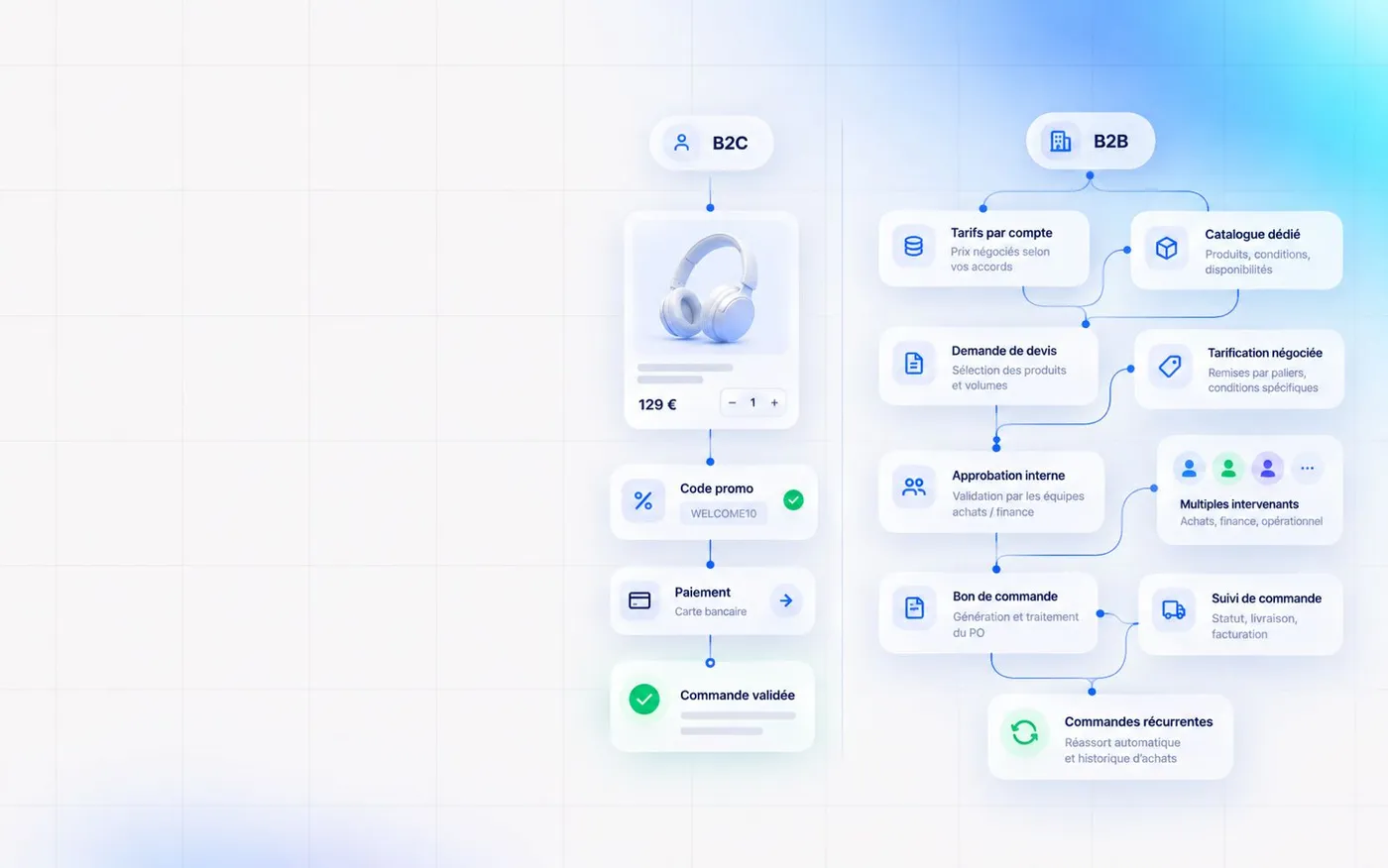
Public demos show consumers buying sneakers. That is misleading. Consumers buy occasionally, on impulse, and they enjoy shopping. B2B buyers purchase often, in volume, by the rules, and are measured on the time it takes. Everything that makes B2B purchasing tedious for a person makes it ideal for an agent.
B2B is also the most demanding terrain. A consumer agent compares public prices. A business agent must apply a negotiated price, volume discounts, an approved product list, an approval workflow and account-specific payment terms. That is exactly where most suppliers are not ready.
The real obstacle: your pricing logic
Ask your team one question: what is the net delivered price of this item for this customer, today? Then count how many systems and people it takes to answer.
In most companies we work with, the answer is pieced together from several places: a price list in the ERP, exceptions in a spreadsheet owned by sales, a special arrangement known to a single rep, a freight charge calculated by hand. A person knows how to reconcile those sources. An agent does not. And an agent that gets two different prices for the same request draws the only safe conclusion: you cannot be trusted.
That is why agent readiness is not an AI project. It is a commercial data governance project that happens to make your company readable by AI.
The Nuevamed agent-readiness grid
| Level | What an agent can do | What it requires from you | Sign you are there |
|---|---|---|---|
| 1. Structured catalogue | Understand what you sell | Normalized attributes, unique identifiers, complete and current product data | Product pages are generated from a single source, with no re-keying |
| 2. Customer-specific pricing exposed | Compute the real price for a given account | Centralized pricing logic, available through an API, authenticated per customer | The same call returns the price that will actually be invoiced |
| 3. Reliable availability | Commit to a credible lead time | Stock and lead times synced in near real time with the warehouse | The gap between promised and delivered is measured and small |
| 4. Delegated ordering | Place and track an order | Payment or credit authorized for agents, approval rules encoded, tracking via API | A customer can order without involving your customer service team |
| 5. Machine-readable terms | Reason about your commitments | Terms of sale, returns, warranties and service levels published as structured data | Your terms no longer live only in a PDF |
Most B2B suppliers sit between levels 1 and 2 today. Moving to level 2 is the most expensive and the most decisive step: it is what turns a storefront into a trading partner for a machine.
What an agent will not forgive
A human buyer tolerates a lot: an incomplete product page, an approximate lead time, a price to be confirmed by phone. They know your rep and give you the benefit of the doubt.
An agent extends no credit. Three flaws are enough to exclude you: data that changes from one request to the next, availability announced then contradicted, a term it cannot interpret. The exclusion is silent. There is no complaint and no lost RFP, just a decline in orders that nobody in your company can explain.
What we recommend for the next twelve months
- Map your pricing logic. List every source that contributes to a net price: lists, agreements, discounts, fees. Name a single owner for that logic.
- Centralize, then expose. Make the ERP, or a dedicated pricing layer, the only source of truth, then expose customer-specific pricing through a secure API. This is the core of the work.
- Make availability reliable. Measure the gap between promised and actual lead times, and close it before you expose it.
- Structure your terms. Turn your terms of sale into data, not just legal text.
- Pilot with one customer. Pick a large, willing account and test a fully automated ordering flow on a narrow scope.
To place this work within your e-commerce roadmap, our B2B e-commerce guide walks through the steps and platform choices.
What not to do
Do not build a chatbot on your website thinking it addresses this shift. A chatbot serves a human visitor; the point here is to serve your customer's agent, which will never visit your site.
And do not wait for the protocols to settle. Standards will change; your pricing data is the prerequisite for all of them. The groundwork is the same whichever standard wins.
Conclusion
The storefront has been a counter, a printed catalogue, then a website. It is becoming an API. The companies that understand this will not win because they adopted AI first, but because they put their pricing in order at the moment their customers stopped checking it themselves.
Nuevamed helps distributors and manufacturers centralize their pricing logic and expose their catalogue through APIs, including with Shopflow and our cloud and API integration practice.
Sources and references
Related expertise
Explore the expertiseFacing a similar challenge in your organization?
Discuss your project