
Business architecture
Domain boundaries built with Actions and typed DTOs, keeping your business rules separate from controllers and Eloquent models.
Technology · Laravel
We design, develop and evolve Laravel platforms in Montreal and across Canada: B2B client portals, custom internal tools, workflow orchestration and business APIs connected to your ERP and existing systems.
What we do
We combine Laravel's natural speed with disciplined software architecture, from initial business planning through to production updates.
Domain boundaries built with Actions and typed DTOs, keeping your business rules separate from controllers and Eloquent models.
Automated tests with Pest or PHPUnit, Larastan static analysis, Laravel Pint standards and systematic code reviews.
Secure REST APIs (Sanctum, Passport), Redis queues monitored with Horizon and resilient ERP/CRM connectors.
Tracking Laravel's annual releases, zero-downtime schema migrations and new features delivered in verifiable increments.
Your concerns
Yes, provided the framework is treated as a fast foundation, not a substitute for architecture. We isolate business logic in dedicated layers, strictly type exchanges and use Eloquent's preventLazyLoading to catch unintended lazy loading. This helps us build B2B platforms and software products that handle high volumes without accumulating technical debt.
We use Laravel's native queues backed by Redis and managed through Horizon. Catalogue imports, PDF generation, B2B pricing calculations and external API calls run outside the HTTP request cycle. Each job runs asynchronously, can be monitored, has a retry policy with backoff and is isolated after repeated failures.
Laravel's clear, well-documented conventions make handover easier. We deliver standardized code covered by Pest or PHPUnit tests, along with Docker environments and CI/CD pipelines, so your developers or another provider can continue the work without depending on our agency.
In practice
Laravel speeds up routine work. What determines your platform's lifespan is how well it represents your own processes.
Business objects, order states and business rules isolated from the framework and HTTP entry points.
Relational schema, versioned migrations, indexing and queries optimized for your actual volumes, without hidden N+1 queries.
Redis queues, job batches (Bus::batch), the Scheduler and atomic locks for work that should not hold up the user.
Typed API Resources, React or Vue front ends using Inertia.js, or Livewire / Filament admin panels built on the same rules.
Integrations
During planning, we define the data, interfaces and responsibilities for each exchange according to your systems' capabilities and your team's needs.
The right fit?
Laravel is often well suited to B2B portals and business tools that need to launch quickly, provided their evolution and ongoing operation are planned for.
If the analysis shows another foundation serves your need better, we say so and point you to the right option.
Operations
Availability, security and operational responsibilities are defined during planning, then adjusted to the needs of the application and your team.
Separate development, staging and production environments; Docker can help keep them consistent depending on the infrastructure chosen.
Laravel versions and dependencies tracked, tested and deployed on an agreed schedule.
Roles, permissions, secrets and patches addressed according to the risks and access to business data.
Backups and restores tested within the agreed scope; recovery time and data loss objectives are defined during planning.
Errors, performance and queues monitored with suitable tools, including Pulse or Horizon where appropriate.
Agreed code, documentation and procedures delivered to your organization to support a handover without imposed dependency.
Use cases
Three contexts where this approach changes daily life for teams. The interfaces shown are mockups made by our team to illustrate the point, not client projects.
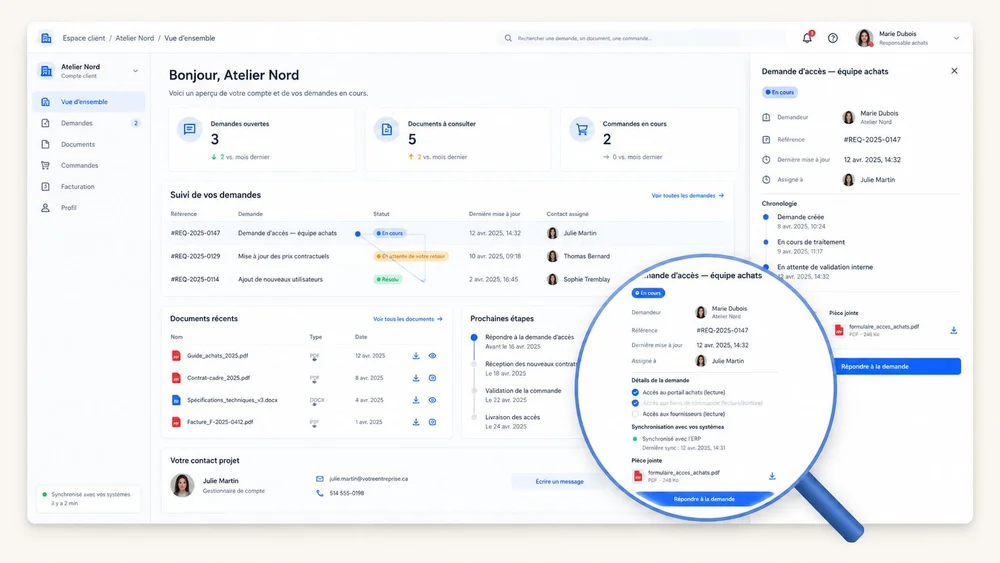
Clients access their documents and track requests according to their permissions, with data connected to your systems.
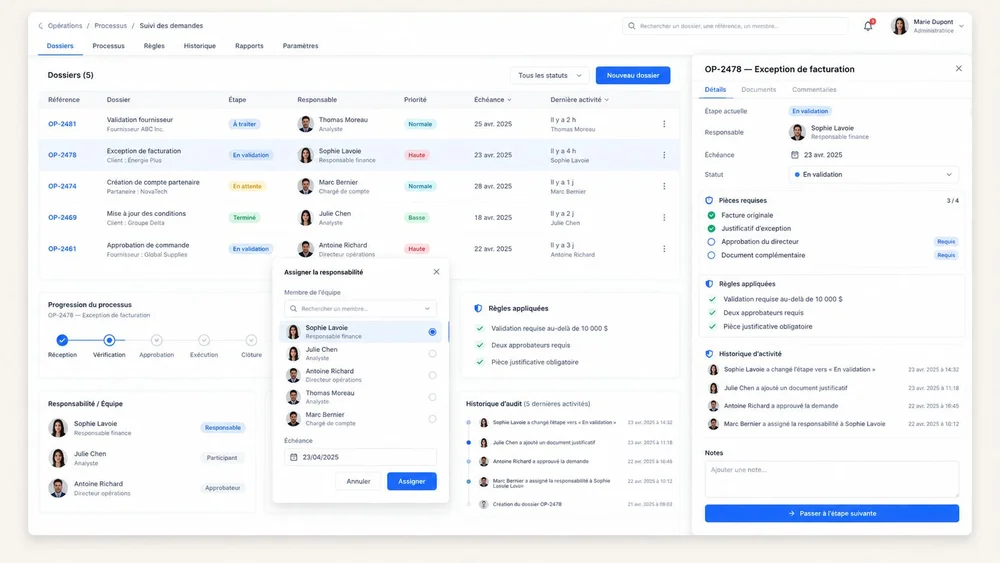
Your teams handle requests in an application that centralizes rules, steps and history.
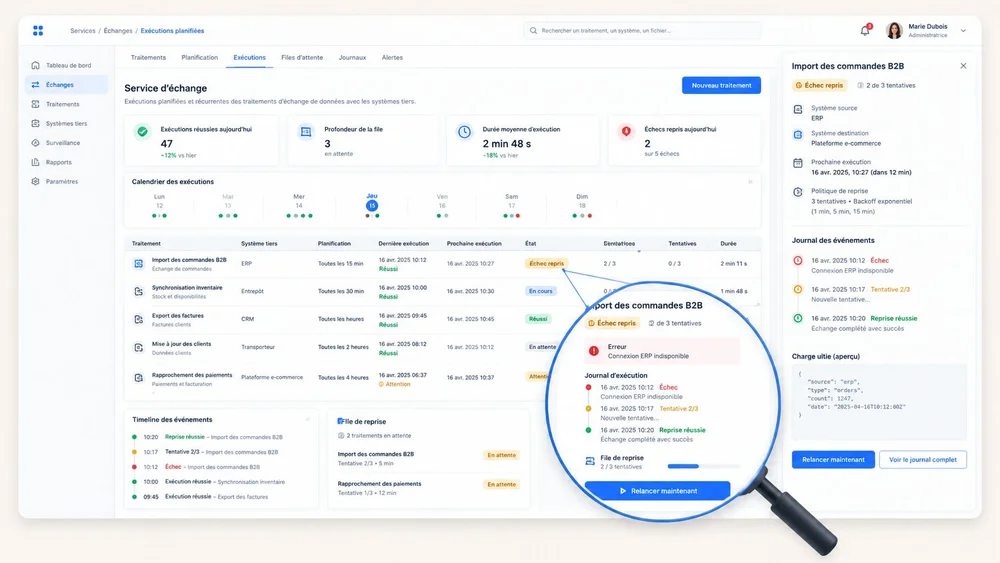
ERP or CRM exchanges are monitored, with recovery adapted to errors and the capabilities of connected systems.
Your project
Share your objectives, technology environment, and constraints, and we will explore how to integrate the platform into your organization.