
Technology · Next.js

Next.js, when the public page must be as fast as an application.

We design, develop, integrate and evolve Next.js platforms for organizations whose pages must be found, served fast and connected to separate content and services.

Next.js logotype
Next.jsReact web framework

What we do

Design, develop, integrate, evolve.

We work across the full life of the application, from initial framing to the changes that follow the release.

Design

Domain boundaries, interface contracts and architecture defined with your technical and business teams.

Development

Versioned code, automated tests, code reviews and continuous integration across separate environments.

Integration

Connection to the services, data and applications already in place, through documented interfaces.

Evolution

Upgrades, version bumps and new capabilities planned without interrupting the service.

Your concerns

The questions an organization asks before choosing.

What does server rendering actually bring?
The page arrives already built: it is indexable and displays without waiting for browser-side code to run. On public pages, that difference shows both in measurement tools and in real use.
Does it need a particular host?
Next.js runs on a Node server or on a managed platform. Some advanced features are simpler with a given host: that is a point to settle during framing, not after launch.
How is content managed?
Next.js is not a CMS. It consumes content that lives elsewhere, in a content platform or a database. That choice determines editorial autonomy and is decided alongside everything else.

In practice

Decide, page by page, how it is rendered.

The strength of Next.js is that it does not impose a single rendering strategy. The point is to pick the right one per page type, rather than one default for the whole site.

  1. Rendering strategy

    Static, server or revalidated: each family of pages gets the treatment it needs.

  2. Content source

    Content comes from a dedicated platform, consumed through defined queries.

  3. Performance

    Images, fonts and code splitting treated as decisions, not as a final adjustment.

  4. Measurement

    Loading metrics are tracked before and after each change.

Choosing rendering per page

Stable page
Rendered once at build time, served instantly.
Frequently updated page
Regenerated on an interval defined with you.
Personalised page
Rendered on demand, based on the current session.
Application screen
Rendered in the browser, behind authentication.
Four different treatments, decided by how each page is actually used.

Integrations

An application connected to what you already use.

We start from your existing systems and the interfaces they expose. The exact scope is defined during framing: it depends on each system, not on the technology alone.

Data

  • Relational databases
  • Warehouses and reporting
  • Message queues
  • Caches and indexes

Services

  • Internal APIs
  • Third-party services
  • Authentication
  • Scheduled jobs

Business applications

  • CRM
  • ERP
  • Finance tools
  • Customer service tools

Runtime and quality

  • Continuous integration
  • Logging
  • Monitoring
  • Automated tests

The right fit?

What tips the decision towards Next.js.

Next.js is justified when one platform has to serve both public pages and application screens.

Decision criteria

  • Public pages to indexSearch visibility that matters, across many changing pages.
  • Performance requirementDisplay time treated as a quality criterion, not a bonus.
  • Decoupled contentContent living in a separate platform and feeding several surfaces.
  • Site and app continuityPublic pages and authenticated spaces within one product.

Counterparts to accept

  • Runtime complexityA server to operate, where a static site needed none.
  • Hosting dependencySome features are simpler with a given provider.
  • Framework paceChanges come fast and require regular version upgrades.
  • No CMS includedEditorial autonomy depends on a content platform chosen alongside.

If the analysis shows another foundation serves your need better, we say so and point you to the right option.

Operations

What keeps the platform steady after launch.

Operations are not a contract separate from the project: they are prepared during design and continue at the pace you choose.

Environments

Separate development, staging and production, with the same deployment path every time.

Updates

Dependencies and versions tracked and tested before they are applied.

Security

Access management, logging and fixes applied according to their severity.

Backups and recovery

Verified backups and a documented restore procedure.

Monitoring

Availability, errors and response times watched, with a regular review.

Handover

Documentation and code handed to your organization, with no imposed dependency.

Use cases

What it actually looks like.

Three contexts where this approach changes daily life for teams. The interfaces shown are mockups made by our team to illustrate the point, not client projects.
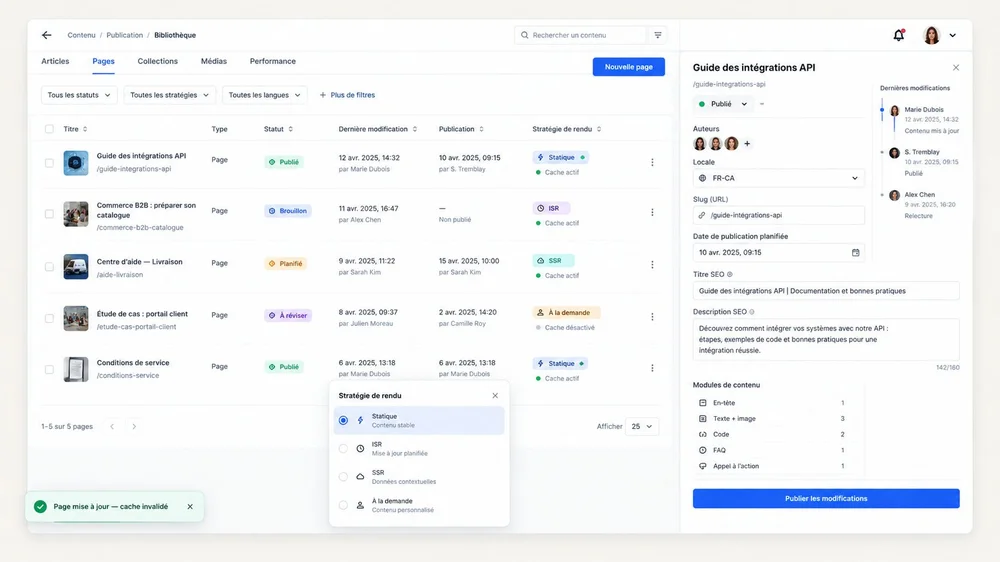
Illustrative mockup of a Next.js content site
Content site

Many pages, served fast

Content managed elsewhere and rendered with the right strategy per page.

Next.js mockup: page management and rendering strategy choice (static, ISR, SSR)
Site and customer space

One platform, two regimes

Indexable public pages and an authenticated space in the same product.
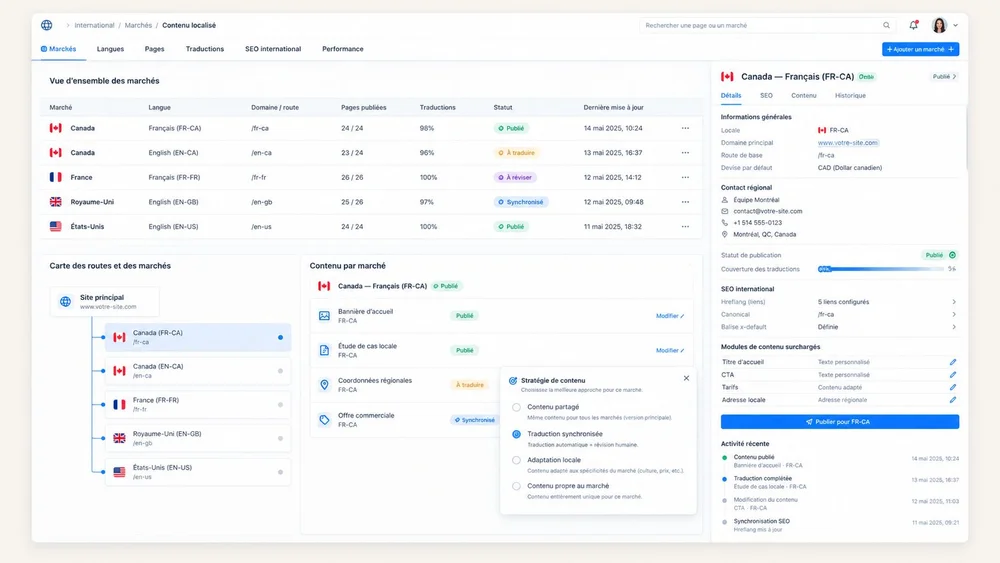
Illustrative mockup of a Next.js international presence
International presence

Several languages and markets

Distinct routes per language, with content specific to each market.

Your project

Let’s talk about your next platform.

Share your objectives, technology environment, and constraints, and we will explore how to integrate the platform into your organization.

  • A precise need or one still to define
  • Architecture discussed before technology
  • Collaboration with internal teams

Describe your need

Fields marked with an asterisk are required.

Privacy and inquiry processing — The information entered is used only to prepare and respond to this inquiry, subject to applicable rules.