
APIs and business services
Custom APIs and services with documented contracts, data validation and access controls suited to the applications that use them.
Node.js Development Firm
We design, develop and evolve Node.js services that connect your applications, data and teams. From business APIs and ERP and CRM synchronization to background processing and real-time exchanges, each service is designed to fit your environment and remain manageable in production.
What we do
From defining exchanges through to ongoing operations, we tailor the architecture to the systems being connected, expected volumes and your team's responsibilities.
Custom APIs and services with documented contracts, data validation and access controls suited to the applications that use them.
Connections to existing ERP, CRM and other services, with clear rules for data exchanges, errors and recovery.
Asynchronous processing, job queues and real-time notifications where the project's needs call for them.
Automated tests, dependency tracking and documentation that make updates and handover to your team easier.
Your concerns
In practice
An integration service is judged as much by how it reports and recovers from a failure as by a successful exchange. We define those behaviours with your team from the outset.
Expected data, responses and errors are documented and checked at the service boundaries.
Tasks that do not need to hold up a response can run through a queue, with appropriate limits and recovery rules.
Structured logs, exchange identifiers and metrics help show where processing stopped.
Timeouts, retries and protective mechanisms are chosen to suit each connected system's capabilities.
Integrations
During planning, we define the data to be exchanged, access and each system's responsibilities. Integrations depend on the interfaces available and your organization's needs.
The right fit?
Node.js can be a good fit for integration services and real-time interfaces. Its suitability also depends on the processing involved, the skills available and operational requirements.
If the analysis shows another foundation serves your need better, we say so and point you to the right option.
Operations
Operations begin at the design stage. Together, we define monitoring, responsibilities and recovery procedures around the needs of the service.
Separate development, staging and production environments, with a deployment process suited to your infrastructure.
Tracking supported Node.js versions and packages, with updates tested on an agreed schedule.
Secrets, permissions, input validation and patches managed according to data sensitivity and identified risks.
Errors, response times and job queues tracked with metrics and alerts suited to critical exchanges.
Recovery procedures and backups defined according to the data hosted and responsibilities agreed with your team.
Code, API contracts and operations documentation delivered within the project scope to support handover to your team.
Use cases
An integration gateway, a shared API or a real-time interface: these mockups illustrate possible uses. They are not client projects.
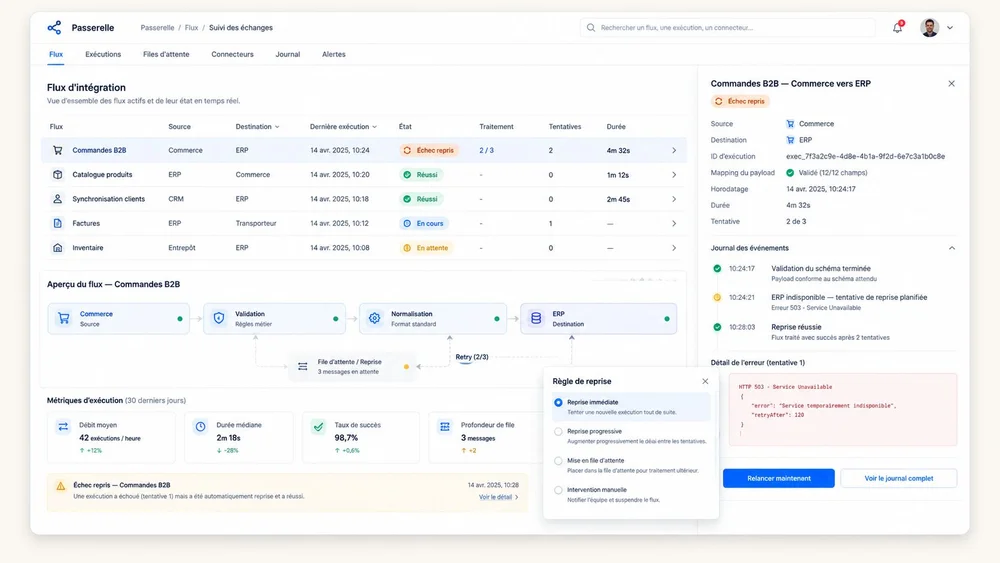
A gateway organizes exchanges between applications, tracks processing and provides for recovery after a failure.
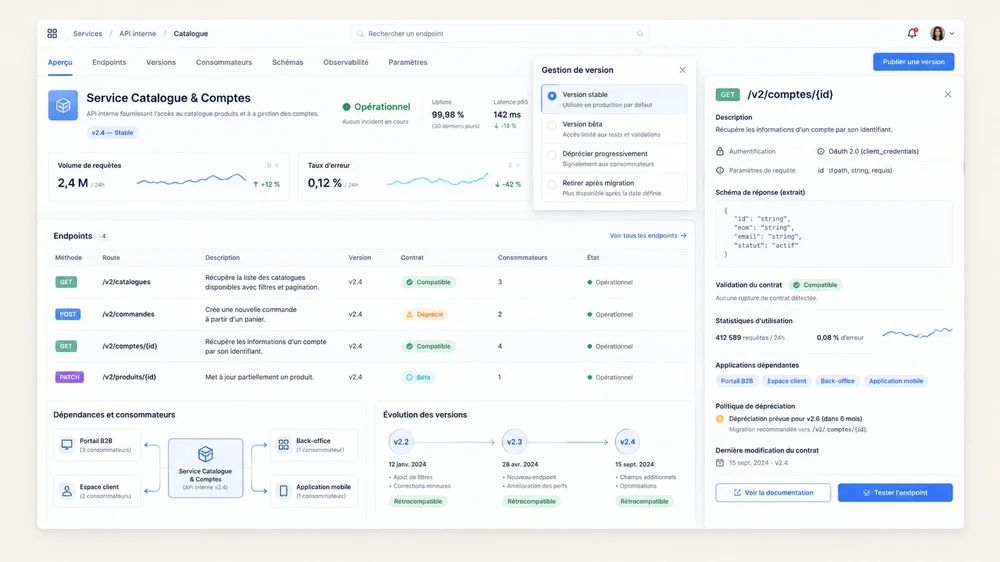
A documented API exposes the data and functions multiple tools need, with appropriate access controls.
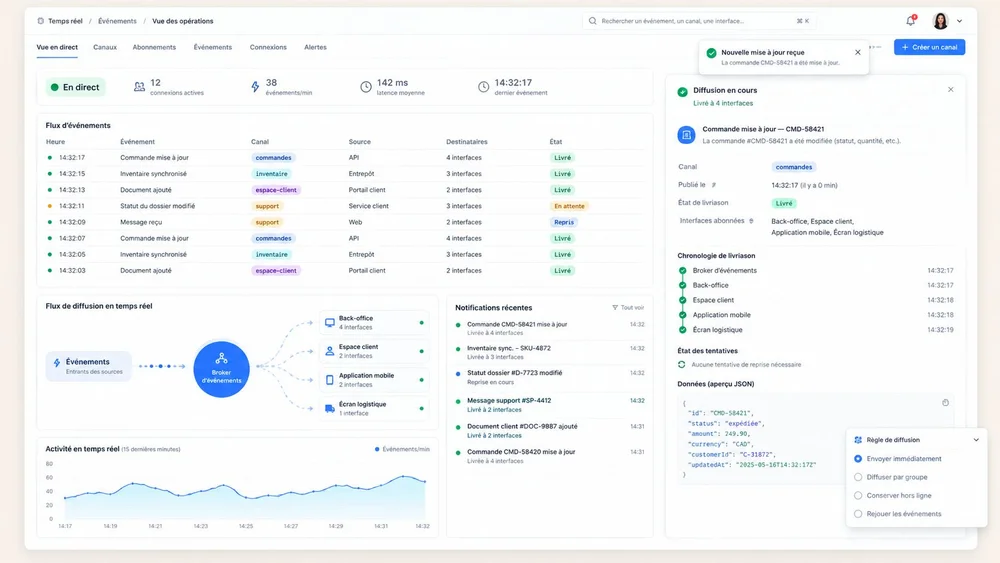
Notifications or status updates reach interfaces without waiting for a manual refresh.
Your project
Share your objectives, technology environment, and constraints, and we will explore how to integrate the platform into your organization.