Platforms
Platform cost is decided in integration, not licensing
Selection committees compare licence grids. Over five years, it is the integrations with the ERP, product information and pricing that set the bill. A method for costing what you are actually buying.

The line everyone compares
In a commerce platform RFP, the first comparison grid is almost always about licensing: monthly subscription, revenue share, per-user cost, transaction fees. That makes sense. The numbers are public, comparable and easy to present to a committee.
They are also misleading. They describe the price of entering a platform, not the cost of living on it. A commerce platform never stands alone: it constantly exchanges data with the ERP, the warehouse, the CRM, payments, tax and product information management. Each of those connections has a build cost, then a maintenance cost, then a change cost. That is where the bill is decided.
The six lines of five-year total cost
| Line | What it covers | Why it is underestimated |
|---|---|---|
| 1. Licence and fees | Subscription, transaction fees, revenue share, paid modules | It is the only line priced precisely, so it gets all the attention |
| 2. Implementation | Design, development, data migration, launch | It is bid, but often on an incomplete scope |
| 3. Integrations | Connectors to ERP, PIM, CRM, warehouse, payments, tax | Each connector is priced as a task, not as an asset to maintain |
| 4. Operations | Hosting, monitoring, security, upgrades, patches | It is spread across budgets and nobody sees the total |
| 5. Evolution | New features, new channels, process changes | It depends on decisions not yet made |
| 6. Exit | The cost of migrating away when the day comes | Nobody wants to discuss it at signing |
Lines 1 and 2 are what committees compare. Lines 3 to 5 decide whether the project pays off. Line 6 reveals how dependent you are.
Why integration dominates
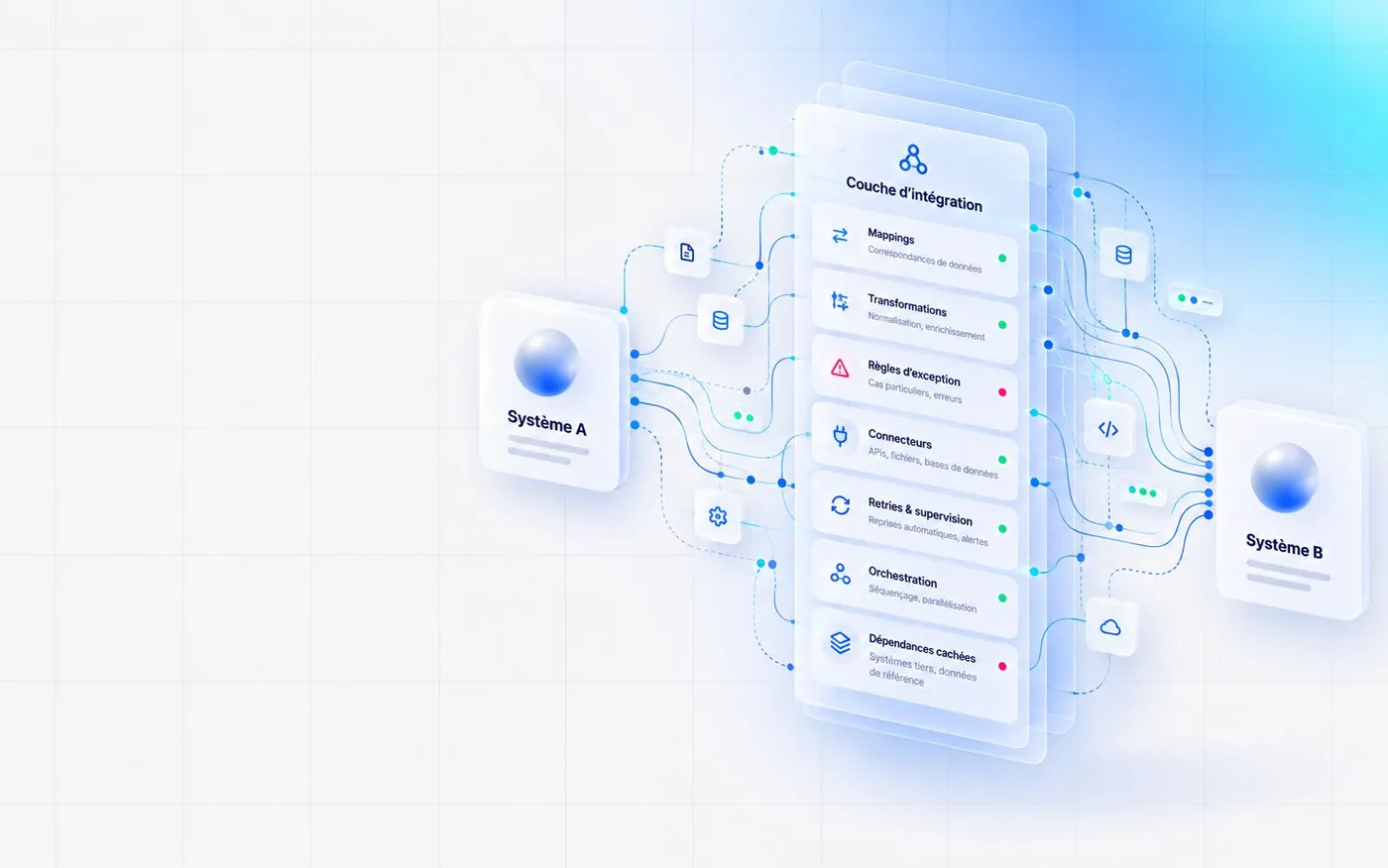
A connector is not a deliverable; it is a standing contract between two systems that evolve independently. When the ERP vendor changes its API, when sales introduces a new discount rule, when the warehouse switches software, the connector has to follow.
Add an arithmetic rule architects know well. If every system is wired directly to every other, the number of links grows much faster than the number of systems: five systems connected pairwise means ten connections; eight systems, twenty-eight. Every system added to a point-to-point architecture costs more than the one before.
That is why two projects with similar launch costs can diverge sharply within three years: one invested in a central integration layer, the other multiplied direct connections.
Three architectures, three ways to move the cost
| Architecture | Where the cost sits | What drives it up | What keeps it under control |
|---|---|---|---|
| All-in-one SaaS (e.g. Shopify Plus) | Licence and fees; workarounds when the model does not fit | Complex B2B logic that forces you to stack apps and side development | A business model close to the platform's standard |
| Licensed, customizable platform (e.g. Adobe Commerce) | Implementation, operations, upgrades | Core customizations that make every upgrade more expensive | Strict discipline: extend, never modify |
| API-first platform (e.g. Shopflow) | Integration and technical governance | A team without an architecture owner | A single, documented integration layer |
None of these architectures is cheapest in absolute terms. Each moves cost to a different line. The right question is not "which costs least?" but "where do we want our cost to sit, given how we are organized?"
The method: price the cost of change
Launch cost is easy to compare. Operating cost, less so. The cost of change, almost never. Yet it is what separates a good decision from a bad one.
We recommend adding three change scenarios to every RFP, priced by each bidder:
- A business rule change. For example, introducing a volume discount for one customer segment.
- A connected system change. For example, replacing the warehouse software.
- A new channel. For example, opening a sales-rep portal or a mobile app.
The spread between bidders on these three scenarios is often more telling than the spread on implementation price.
Seven questions to ask before you sign
- What is the five-year total cost, broken down across the six lines?
- What does a pricing rule change cost, and how long does it take?
- Who owns each connector when a third-party system changes?
- How much of our customization will survive the next major upgrade?
- Are revenue-share fees capped as our volume grows?
- Are our data, including order and pricing history, exportable in a usable format?
- What would an exit cost in three years, and who would carry it out?
A vendor who answers these seven questions precisely will not necessarily be the cheapest. They will be the one whose price you actually know.
Conclusion
Choosing a platform is presented as a technology decision. It is first a financial decision about how the company agrees to pay for change. Organizations that decide on licensing buy an entry price. Those that decide on integration buy a trajectory.
Nuevamed helps finance and technology leaders cost their platforms over five years and design durable integration layers.
Related expertise
Explore the expertiseFacing a similar challenge in your organization?
Discuss your project