Development
Staying on top of Google isn't about a list of tactics. Eight decisions that protect your visibility.
SEO advice tends to sound the same: quality content, clean tags, internal links. It's all correct, and it's no longer enough. Established companies can lose rankings through a business decision that didn't look technical at all: a website redesign, a new brand positioning, a platform migration, or an ungoverned shift in content strategy.

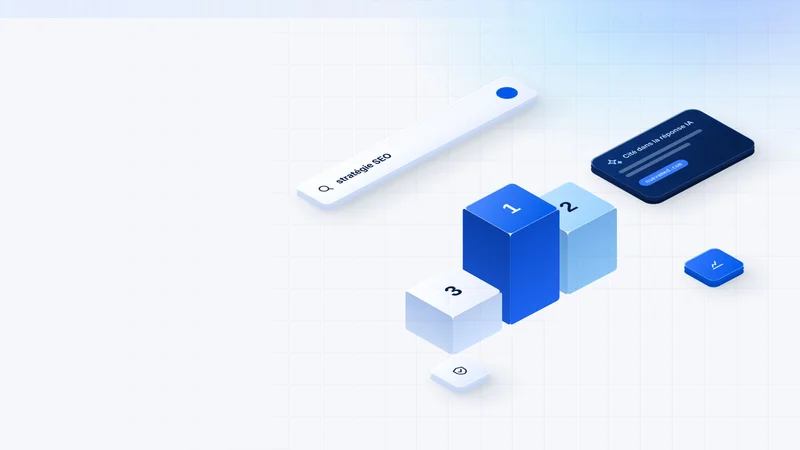
Recommendation: before approving any redesign or messaging overhaul, inventory the pages and search terms that contribute to qualified leads, and require an explicit executive trade-off before removing important signals.
Why the usual advice is no longer enough
Most lists of proven SEO strategies cover the same ground: content depth, search intent, meta tags, structured data, page speed and internal linking. These are useful practices, but they don't create a competitive edge on their own when competitors can apply them too.
Two developments are changing the context in 2026:
- Possible compression of informational clicks: Google sometimes surfaces AI-generated summaries in search results. Their impact on clicks varies by query. See Google's guidance on AI features and your website.
- From ranking to citation: some B2B buyers consult ChatGPT, Perplexity or Claude to compare vendors. Alongside traditional rankings, businesses can ask whether they are cited and which sources support the answer.
Staying visible therefore requires governance and architectural care as well as tag-level improvements.
The foundations: don't lose what you've earned
1. Treat every redesign as a business risk
A visually successful redesign can reduce visibility if important pages, links or content disappear. New brand copy may replace explicit headings with abstract taglines. Removing a relevant phrase from a title, H1 or page content deserves review, without assuming a single keyword determines a ranking.
Before touching design or copy, compile three baseline lists:
- Pages that drive visits and conversions, cross-referenced across Google Search Console, GA4 and your CRM, within each tool's limitations.
- Search queries associated with those visits, mapped by page where the data is available.
- On-page elements providing context: title tags, H1s, opening copy, heading hierarchy and primary navigation link anchors.
Removing an important phrase or navigation link should be a deliberate business decision, not an accidental side effect of a design refresh.
2. Migrate without inventing redirects
When switching CMS platforms or moving to a headless architecture, every legacy URL needs a deliberate, tested outcome before cutover. A permanent redirect (301 or 308) to a page that genuinely serves the same need helps pass existing signals, but doesn't guarantee unchanged rankings. Content deliberately retired with no real equivalent can return an HTTP 404 or 410 status.
A common mistake is mass-redirecting remaining URLs to the homepage to avoid errors. Google may treat irrelevant redirects as soft 404s. Review our CMS migration SEO checklist to govern this process.
3. Give each intent a primary page
When several pages target the same intent with very similar content, they may compete or make results harder to assess. This keyword cannibalization isn't automatic: multiple pages on a site can also serve complementary needs and rank.
Identify a primary page for each commercial intent and give supporting pages distinct roles. For complex products or services, structure the site in layers: a main page supported by use-case and integration pages, as outlined in our guide on explaining a complex product on a B2B SaaS website.
Growth: become the reference on a few topics
4. Pick your battles by buying intent, not raw volume
High-volume terms may be dominated by large publishers and attract people looking for definitions rather than vendors. An acquisition strategy should also consider queries that combine a specific operational need, manageable competition and proximity to a purchase decision.
For a B2B firm, specialized queries tied to a technology, a regulatory requirement such as Québec's Law 25, or an ERP integration can generate more relevant leads than a broad term. Results depend on the market, rankings and conversion, so measure rather than assume the return.
5. Build topical authority, not just an editorial calendar
Publishing regularly on disconnected subjects isn't enough to demonstrate expertise. Coherent coverage can help visitors understand a specialty: a main page for each commercial offering, supported by technical articles addressing buyer objections and linking to relevant resources. It doesn't guarantee a ranking or an AI citation.
Before approving an article, ask: which page or reader need does this piece strengthen? Content can also provide support or education without a direct link to a sale.
6. Deliver information a competitor can't simply copy
Google encourages creators to demonstrate first-hand experience and publish helpful, reliable, people-first content. E-E-A-T is a framework for evaluating quality, not a single ranking factor or a guarantee. An article that only repeats existing material adds little new information.
Elements grounded in your own experience can enrich an article:
- Documented internal data and implementation metrics: an archived production audit recorded 162 URLs, including filter variants, and 6,360 internal-link rows, not necessarily distinct links.
- Real architectural trade-offs and edge cases encountered in practice.
- Your own decision matrices, evaluation grids and reasoned technical positions.
Using AI to accelerate drafting or structure is possible; check claims, sources and added value before publication.
The new frontier: getting cited by answer engines (GEO / AEO)
7. Make your company readable as a verifiable entity
A clear, consistent description can help people and systems understand a company, without guaranteeing an AI assistant will recommend it. Three areas deserve attention:
- Off-site consistency: check your company's name, address, capabilities and documented work across your website, Google Business Profile, LinkedIn, directories and partner sites.
- Structured data (JSON-LD): use relevant types such as Organization, Service, Person or FAQPage when supported by visible content. alternateName can identify another name for the same entity when appropriate. Google requires no special markup for its AI search features.
- Accessible code: crawlers don't all process JavaScript the same way. Server-side rendering (SSR) or static generation can make core copy, tables and metadata available in the initial HTML.
8. Measure share of citations and pipeline, not just clicks
A drop in informational clicks alone doesn't prove a loss of commercial influence. Analyze queries, pages and outcomes together; visitors from AI answers aren't necessarily closer to a decision.
Adapt your executive dashboard to track four indicators:
- Impressions and average position in Search Console for commercial and transactional queries.
- Qualified leads and pipeline associated with organic landing pages, accounting for attribution limits.
- AI referral traffic in analytics, recognizing that some visits may be attributed elsewhere or not identifiable.
- AI citation share: regularly test a fixed set of commercial prompts across assistants and record whether your business is named, how it is described and what sources are cited. Answers vary with context and time.
The eight decisions at a glance
| Decision | Question for leadership | Warning sign |
|---|---|---|
| 1. Controlled redesign | Which pages and terms drive current leads? | The homepage title drops the primary keyword for a vague tagline |
| 2. Clean migration | Does every legacy URL have a tested outcome? | Pages without equivalents are mass-redirected to the homepage |
| 3. One primary page per intent | Which page answers this commercial query? | A blog post and service page cover the same need without distinct roles |
| 4. Chosen battles | Where is buying intent high and competition manageable? | The strategy only targets broad, high-volume keywords |
| 5. Topical authority | Which reader need or service page does this post support? | Scattered topics with no links to relevant resources |
| 6. Information gain | What evidence, data or method does this add? | Generic content published without lived experience or proof |
| 7. Readable entity | Is our company described clearly and consistently? | Hard-to-crawl content or conflicting descriptions |
| 8. Adapted measurement | Are we cited and driving qualified leads? | Reports track only total sessions |
FAQ
How long does it take to recover after a redesign-related ranking drop?
The timeline depends on the cause, recrawling and competition; there is no guaranteed recovery period. Quickly investigate content changes, missing redirects and indexing blocks, then monitor affected pages and queries in Search Console.
Should we rewrite old articles or publish new ones?
Start by auditing existing content. Updating a useful page that already receives impressions can be worthwhile; compare its potential with a new article. For obsolete pages with no equivalent, a 404 or 410 can be appropriate; merge when another page genuinely serves the same need.
Does Google penalize AI-assisted content?
Google doesn't automatically penalize the use of AI. Its guidance focuses on content quality and usefulness; producing content at scale primarily to manipulate rankings can violate spam policies. Verify facts and contribute original value.
Does structured data (Schema.org) directly improve rankings?
It can help search engines understand content and make some pages eligible for rich results, without guaranteeing a display or higher rankings. Google requires no special markup for its AI features, and FAQ rich results are limited to certain eligible sites.
How can I track whether ChatGPT or Perplexity recommends my company?
Build a benchmark of ten to fifteen questions your buyers actually ask, run them regularly in AI assistants and record whether your brand is cited, how it is described and which sources are used. Keep the date and context: answers can vary.
Conclusion
Companies that protect search visibility do more than chase algorithmic changes. They govern it as a business asset: identifying pages and queries that contribute to results, monitoring redesign changes, and publishing clear, verifiable expertise. None of these steps guarantees a ranking or citation.
Planning a website redesign or looking to strengthen your visibility across Google and AI search engines? Contact the Nuevamed team to protect and grow your search equity, or explore our SEO and AI search strategy services.
Facing a similar challenge in your organization?
Discuss your project