Development
Laravel for enterprise applications: when it's the right choice, and when it isn't
Framework decisions are often made in a single meeting, based on the preferences of whoever is on the team at the time. Yet they can commit the company for seven to ten years: maintenance costs, hiring, security, integration capacity. Laravel is an excellent choice in many cases. Not in all of them.

Recommendation: choose your framework based on ten-year total cost and on the team that will maintain the application, not on the preferences of the team that builds it.
The real question isn't technical
Most articles about Laravel list its features: SQL injection protection, queues, caching, testing tools. Those features exist, and other frameworks offer them too. For leadership, the question lies elsewhere:
- What will the application cost to maintain in five years?
- Can we replace the team or vendor without rebuilding everything?
- Can the application connect to the systems that matter: ERP, CRM, payments, warehouse?
- Will the framework still be supported, and how often will it need upgrading?
These are the criteria Laravel should be judged on.
Five reasons Laravel suits enterprise applications
1. Solid baseline security, as long as you follow it
Laravel includes the expected protections: parameterized queries against SQL injection, CSRF tokens, password hashing, encryption, rate limiting. A team that uses these mechanisms correctly and follows the framework's conventions reduces its exposure to common vulnerabilities; conventions alone are not enough without appropriate configuration, security reviews and testing.
The nuance matters: the framework reduces risk, it doesn't eliminate it. An application's security depends mostly on access management, permissions and personal data handling, which remain design decisions.
2. Integration capabilities that fit how companies actually work
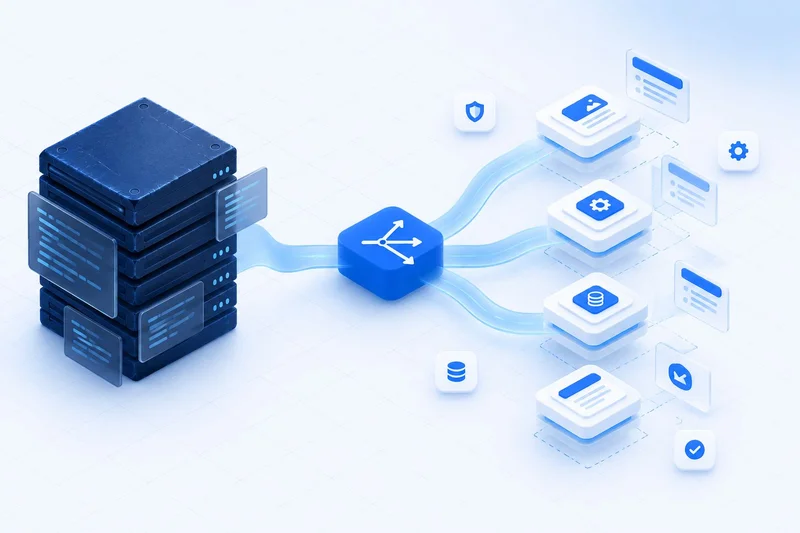
An enterprise application spends most of its life exchanging data with other systems. Laravel offers proven tools for this: API building, queues to process exchanges in the background, automatic retries on failure, scheduled jobs.
In practice, an order can be sent to the ERP, an invoice to accounting and a customer to the CRM without blocking the user. If one system is briefly unavailable, designing cloud and API integrations around message durability, idempotency and monitored retries reduces the risk of loss or duplication, without by itself guaranteeing that no data will be lost.
3. Performance that's sufficient for the vast majority of cases
With well-designed caching, queues and an architecture that lets you add servers, Laravel can support high-volume platforms. Performance problems in business applications don't necessarily come from the framework: the database, integrations and poorly designed queries are common areas to investigate. Measurements and load tests help identify the actual limits.
4. A structured vendor and a predictable support cycle
Laravel ships one major release a year. Each release receives bug fixes for 18 months and security fixes for two years, according to the Release Notes — Support Policy. That schedule makes upgrades plannable and budgetable.
The company behind the framework has also matured: it raised US$57 million from Accel in 2024 to develop its products and hosting offering (Accel invests $57M into Laravel). For an enterprise buyer, that's a signal of longevity, not a guarantee.
5. A developer pool that reduces dependency risk
PHP remains one of the most widely used languages on the web, and Laravel is a widely used framework in that ecosystem. A Laravel application that follows conventions can be taken over by another team, provided the code, documentation and access credentials are transferable. For an executive, that's a way to reduce dependence on one vendor or a few key people, not eliminate it.
When Laravel isn't the right choice
Honest advice includes the cases where you should choose something else:
- Your organization is standardized on Microsoft. If your internal teams already maintain .NET applications tied to Azure, Entra ID and Dynamics, adding a different technology creates a lasting skills cost.
- The application relies on heavy computation or machine learning. Large-scale data processing or custom models belong in Python, Go or Java. Laravel can orchestrate those services, not replace them.
- The need is standard. If a SaaS product covers 90% of the requirement, building custom, in Laravel or anything else, can be hard to justify economically. That threshold is indicative, not a rule: integration costs, constraints and key processes also matter.
- There's no maintenance budget. A Laravel application left un-upgraded for three years falls out of the support window and accumulates expensive technical debt. That's true of any framework, but Laravel's annual cadence makes it more visible.
A comparison for decision-makers
| Criterion | Laravel (PHP) | .NET | Java (Spring) | Node.js |
|---|---|---|---|---|
| Time to market | Can be very fast for a conventional business application | Can be fast with an established Microsoft team and foundation | Can be slower if the enterprise foundation must be built | Can be fast for a lightweight application with a JavaScript team |
| Developer pool | Large in the PHP ecosystem | Large in enterprise | Large in large accounts | Large in the JavaScript ecosystem |
| Microsoft ecosystem integration | Good through available APIs and connectors | Closely integrated with Microsoft tools | Good through available APIs and connectors | Good through available APIs and connectors |
| Heavy computation | Often delegated to specialized services | Suitable depending on workload and libraries | Suitable depending on workload and libraries | Often delegated to workers or specialized services |
| Ideal use case depending on context | Business platforms, portals, commerce, integrations | Microsoft organizations, internal apps | Very large systems, financial sector | Real-time, lightweight apps |
This table reflects general tendencies, not rules or a universal ranking. Costs and timelines depend on scope, existing foundations and team experience. The right choice depends mostly on the team that will maintain the application.
The architecture we recommend
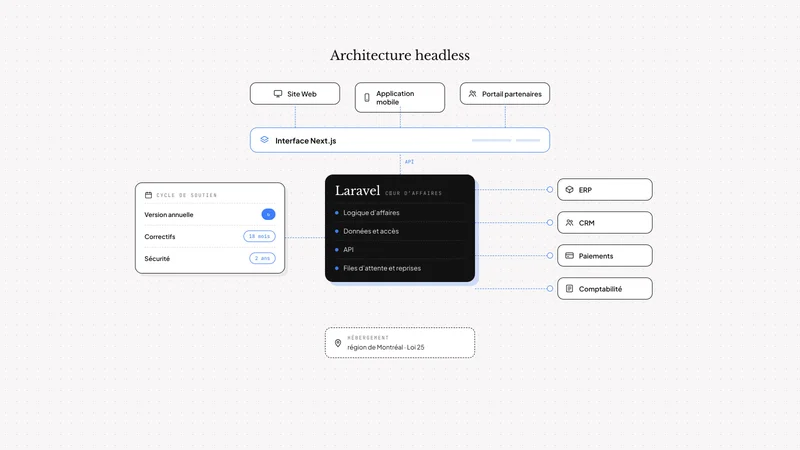
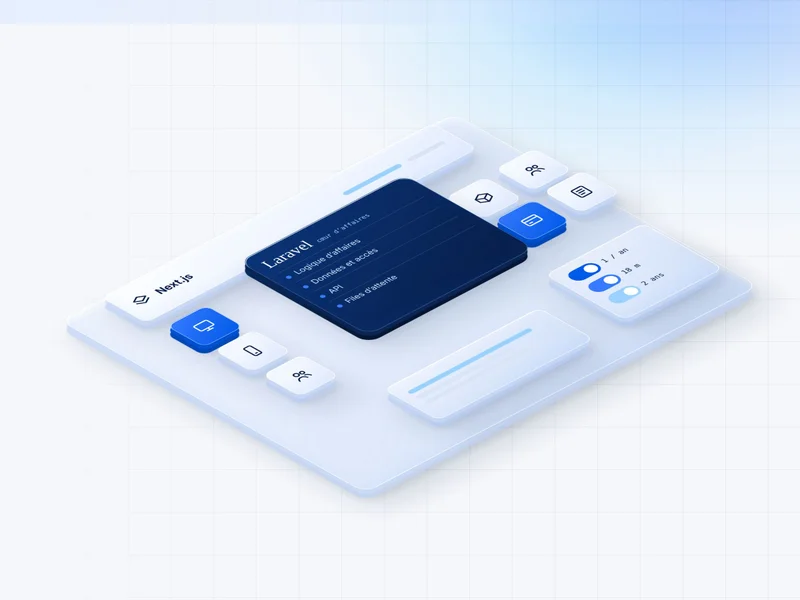
For business platforms, we favour a clean separation: Laravel for business logic, data and integrations; Next.js for the interface. This headless architecture lets you evolve the interface without touching the core, as long as API contracts are respected, and serve several channels (website, mobile app, partner portal) from the same services. It also entails the operational cost of deploying and monitoring two applications.
It's the architecture behind Shopflow, our headless commerce platform, for B2B and B2C, built on Laravel and Next.js.
In Québec, hosting is part of the decision. Law 25 does not, by itself, require data to be hosted in Canada, but Québec's private-sector privacy regime notably requires a privacy impact assessment before personal information is communicated outside Québec or certain processing operations are entrusted to a person or organization outside Québec. Hosting in the major cloud providers' Montréal region can make some aspects of that process easier, but storage geography alone neither establishes compliance nor rules out an assessment: remote access, transfers and subcontractors matter too. Have legal counsel confirm the applicable obligations.
Six questions to ask before you choose
- Who will maintain the application in five years, and which technologies does that team know?
- Which systems must the application read from and write to?
- Does existing software already cover most of the need?
- What annual budget is planned for upgrades and security?
- Where will the data be hosted, and is a privacy assessment required?
- Will the code follow the framework's conventions, so another team can take it over?
FAQ
Is Laravel robust enough for a large enterprise?
Yes, for most business applications: portals, transactional platforms, internal tools, integrations. Robustness depends more on architecture, testing and operations than on the framework itself.
Is Laravel secure?
It includes the expected baseline protections and receives security fixes for two years per release. Real-world security depends on access design, personal data handling and regular upgrades.
What does maintaining a Laravel application cost?
It covers the annual framework upgrade, security patches, integration monitoring and functional changes. Budgeting for it from the start reduces the risk of an expensive rebuild a few years later; the amount depends on the application's scope and condition.
Can a Laravel application connect to SAP, Dynamics or Salesforce?
Yes, where the available editions, licences and APIs allow it. Laravel can consume those APIs, but complexity depends on authentication, quotas, functional limits and versions, as well as data quality and business rules. It cannot be reduced to the choice of framework.
Laravel or a SaaS platform?
If a SaaS product covers most of the need without working around your key processes, it's usually more cost-effective, depending on licences and integration costs. Custom development is justified when the application is a competitive advantage or when integrations go beyond what the SaaS allows.
Conclusion
Laravel is an excellent choice for an enterprise application when the need is specific, integrations are numerous and a maintenance budget is planned. It isn't necessarily the right choice for an organization fully standardized on Microsoft, or for a need that existing software already covers. The decision is best made on total cost and on the team that will live with the application, not on the preferences of the team that builds it.
Nuevamed designs and maintains custom enterprise applications in Laravel and Next.js, connected to its clients' ERP, CRM and payment systems. Evaluate your Laravel project.
Facing a similar challenge in your organization?
Discuss your project